
Last updated June 28, 2026
Seasonal Garage Door Care for Northridge: Year-Round Homeowner’s Guide
Most Northridge homeowners assume Southern California’s mild climate means their garage door is basically maintenance-free. That assumption is costing people thousands of dollars in premature replacements. The truth is that our specific combination of relentless UV exposure, dry-heat cycling that pushes past 100°F in summer, occasional hard rain in winter, and Santa Ana wind seasons in fall creates a wear pattern that’s just as punishing as snow-belt climates — it just looks different. This guide walks you through exactly what to inspect and maintain in each of Northridge’s four distinct stress windows so your door lasts closer to 20 years than 12.
Quick Answer
Seasonal garage door maintenance in Northridge means addressing four specific stress windows: post-rain track inspection in spring, thermal expansion checks in summer, weatherstripping assessment before Santa Ana season in fall, and opener electronics protection during winter freeze nights. Completing even the basic tasks in each window can extend the working life of your door by five to eight years and head off the most common emergency failure modes before they happen.
Table of Contents
- Spring (March–May): Post-Rain Inspection and Foundation Drainage
- Summer (June–September): Heat Expansion, Lubrication, and Track Alignment
- Fall (October–November): Weatherstripping and Santa Ana Wind Prep
- Winter (December–February): Freeze Nights and Opener Electronics
- The “Do Once, Benefit All Year” Task List
- Common Mistakes to Avoid
- When to Call a Professional
- Frequently Asked Questions
Spring (March–May): Post-Rain Inspection and Foundation Drainage
Northridge averages only about 14 inches of rainfall per year, but when it comes, it often arrives in concentrated bursts — think the atmospheric river events that have soaked the West Valley in recent winters. That pattern means your garage door and its immediate surroundings soak up a lot of water in a short window, then dry out almost completely for months. That cycle is harder on materials than steady, moderate rainfall.
The first thing to check every spring — ideally in late March once the main rain season has wound down — is the track mounting at the floor level. Look for rust streaking on the vertical track sections nearest the ground. Surface rust at this height almost always signals that water is pooling near the door opening rather than draining away from it. In Northridge neighborhoods like Reseda-adjacent tracts and older Devonshire corridor homes, slightly positive drainage slopes toward the garage slab are common, and they funnel runoff directly under the door.
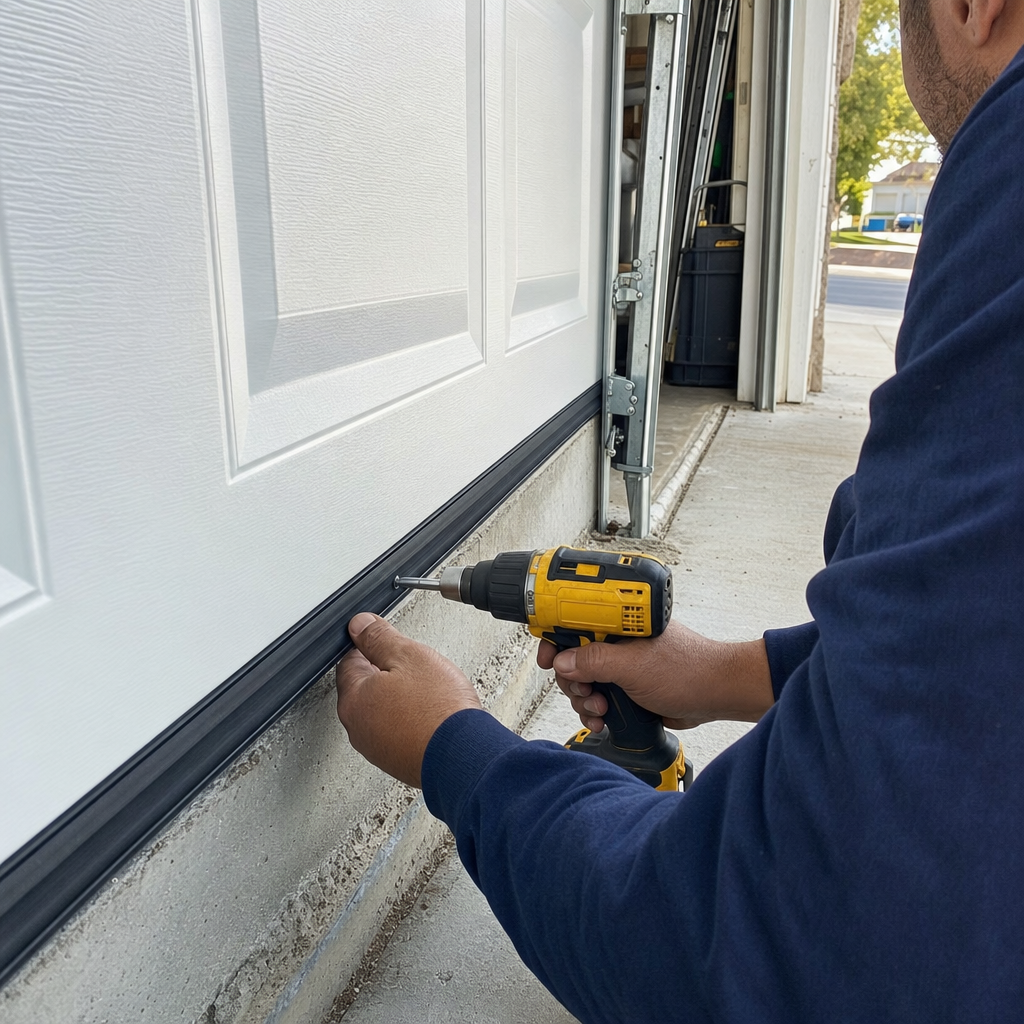
While you’re down there, run a gloved finger along the bottom rubber seal. If it’s cracking, brittle, or missing chunks, water has likely been working under the door. A compromised bottom seal also invites rodents and insects during drier months — a secondary problem that compounds quickly.
Spring Checklist
- Inspect both vertical track sections for rust streaks and standing-water marks at floor level.
- Test the bottom weatherseal — press it flat against the concrete and look for daylight gaps wider than 1/8 inch.
- Check that the floor drain or driveway slope diverts water away from the door opening.
- Wipe down the tracks with a dry cloth and look for grit, pebble, and debris accumulation from winter runoff.
- Operate the door manually (pull the emergency release cord) and feel for any new binding that wasn’t there last fall.
Summer (June–September): Heat Expansion, Lubrication, and Track Alignment
Northridge summers are not gentle. Temperatures in the West San Fernando Valley regularly exceed 100°F from late June through early September, and on peak heat days the metal components of your garage door system can reach surface temperatures significantly above ambient air. Steel tracks, torsion bar components, and hardware expand measurably at those temperatures — and that expansion is exactly what causes seasonal binding.
Here’s what happens in practice: a steel track that was installed with factory-spec clearances in 60°F weather is operating at tighter tolerances when it’s 105°F outside. If the track was even slightly out of plumb at installation, thermal expansion amplifies the misalignment. We’ve seen this pattern repeatedly in Northridge homes, particularly in west-facing garages where the door surface absorbs direct afternoon sun from around 2 PM through sunset.
Summer is also the worst time to be running a dry door. Whatever lubrication was applied in spring has partially evaporated or been thinned by heat. Use a silicone-based spray or a lithium grease on the rollers, hinges, and torsion spring — never WD-40, which acts as a degreaser and leaves metal components dry within weeks. For openers, check the drive mechanism: chain-drive units on LiftMaster and Craftsman models tend to sag slightly in heat, and a chain with more than 1/2 inch of sag at the midpoint needs adjustment before it skips the sprocket.
Summer Checklist
- Lubricate rollers, hinges, and torsion spring with silicone or lithium grease — not petroleum-based spray.
- Inspect the drive chain or belt on your opener for sag; adjust per the manufacturer spec (typically 1/4 to 1/2 inch deflection).
- Check the door’s balance: disconnect the opener and lift the door manually to waist height. It should stay put within a few inches. A door that slams down or shoots up has a spring tension problem.
- On west-facing garages, check the top section panels for UV paint fade and surface warping — Clopay and Amarr steel panels are generally more UV-stable than thinner imported panels.
- Test the auto-reverse safety feature: place a 2×4 flat on the ground under the door. The door should reverse on contact. If it doesn’t, the opener’s force settings need adjustment before summer heat makes them unpredictable.
Fall (October–November): Weatherstripping and Santa Ana Wind Prep
The Santa Ana wind events that hit the greater Northridge area — typically running from October through December with the strongest events in late October and November — push fine dust, dry debris, and combustion particles from surrounding brush fires into every gap a garage door has. If your weatherstripping is compromised going into Santa Ana season, you’ll find a visible dust line on your garage floor by morning after the first significant wind event.
More critically, that same dust infiltration finds its way into the opener motor housing, especially on older Chamberlain and Genie units where the housing vents aren’t sealed tightly. Accumulated dust inside a motor housing acts as an insulator, causing the motor to run hotter than spec. Over two or three Santa Ana seasons, it measurably shortens motor lifespan.
Fall is the right time to replace side-mount weatherstripping if it shows any compression set — meaning the foam or rubber no longer springs back when you press it. Quality vinyl bulb-style seals typically last three to five years in Northridge’s UV environment. Also check the top seal where the door meets the header: gaps there let wind noise, dust, and occasional rainwater from horizontal-driving storms work into the garage.
Fall Checklist
- Replace side weatherstripping if it shows compression set or cracking — don’t wait for a Santa Ana event to confirm the gap.
- Check the top header seal and look for daylight or gaps wider than a pencil diameter.
- Blow out the opener motor housing with compressed air before the main wind season starts.
- Inspect the door panels for dents or surface damage from summer use; seal any paint chips on steel doors before fall moisture accelerates rust.
- Test the door’s manual operation again and re-lubricate after the summer heat has cycled off — cooler temperatures make this the best time for lubrication to set properly.
Winter (December–February): Freeze Nights and Opener Electronics
Northridge doesn’t freeze often, but it does freeze. Nighttime lows dip below 32°F on an average of four to eight nights per year — and those nights matter far more for your opener’s electronics than for the door itself. Modern garage door openers, including LiftMaster’s 8500 series and Chamberlain’s myQ-enabled units, use logic boards and capacitors that are rated for a minimum operating temperature. On a 28°F night, a garage that’s uninsulated and unheated can push those components close to or below their rated floor.
The most common symptom we see after Northridge freeze nights is an opener that runs sluggishly or refuses to start until mid-morning once the garage has warmed up. If this happens to your Raynor or Wayne Dalton opener more than once a season, it’s worth looking at insulating the garage door itself — an insulated steel or polyurethane-core door keeps the interior ambient temperature several degrees warmer than an uninsulated door, which is often enough to keep electronics in their operating range.
The second winter concern is the bottom seal freezing to the concrete. On nights when moisture has been present, a rubber bottom seal can bond lightly to the slab. Forcing the door up when it’s frozen down can strip the seal or, more seriously, damage the torsion springs by putting asymmetric load on them. If your door feels heavier than usual on a cold morning, check visually before hitting the opener button.
Winter Checklist
- Test your opener’s cold-start performance on the first cold morning of the season — sluggishness is an early warning sign, not a reason to wait.
- If the bottom seal freezes to the slab, use a heat gun or warm water before operating the opener — never force it.
- Check the battery backup on your opener, if equipped; cold temperatures reduce battery capacity, and a backup that works in September may not work in January.
- Inspect the torsion spring above the door for any visible cracks at the coil ends — winter is when springs that were already fatigued from summer stress tend to break.
- If your garage lacks insulation, consider whether an insulated replacement door makes sense — Garage Door Installation in Northridge can walk you through the R-value options for our specific climate.
The “Do Once, Benefit All Year” Task List
Some maintenance actions address multiple seasonal risks simultaneously. Do these three tasks once — ideally in late October when temperatures have dropped from peak summer but before the main Santa Ana season — and you’ve covered the most common failure modes regardless of what season throws at the door next.
1. Full Hardware Inspection and Tightening
Every bolt, nut, and lag screw on the track mounting brackets vibrates slightly with every door cycle. A door that runs 4 cycles per day does roughly 1,460 cycles per year. Over eight years, that’s nearly 12,000 vibration events per fastener. Use a socket wrench to check every visible bolt on the track brackets, spring anchor plates, and opener mounting hardware. A loose bracket on the vertical track is one of the most common causes of sudden misalignment — and it takes about 20 minutes to check the whole system.
2. Full-System Lubrication
Apply silicone spray or white lithium grease to: all rollers (at the axle, not the wheel), all hinge pivot points, the torsion spring (a thin coat along the full length of the coil), the lock bar and its guides if your door has one, and the drive rail if it’s a screw-drive opener. This single pass protects against summer heat evaporation, fall dust infiltration, and winter lubrication thickening — three separate seasonal risks addressed in one session.
3. Safety Feature Verification
Test both the auto-reverse mechanical trigger (place a 2×4 under the door) and the photo-eye sensors (wave a broom handle through the beam mid-cycle). Confirm the manual release works smoothly. Check the wall button and any remote controls for delayed response. These safety systems are not just legal requirements — a door that doesn’t reverse properly is a door that can cause serious injury. On LiftMaster, Genie, and Chamberlain openers, the force adjustment dials are typically accessible on the back of the motor unit without tools.
Common Mistakes to Avoid
- Using WD-40 as a garage door lubricant. WD-40 is a water displacer, not a lasting lubricant. In Northridge’s dry heat it evaporates within weeks and leaves metal surfaces drier than before — use silicone spray or white lithium grease instead.
- Ignoring rust at the base of the vertical tracks after rain. Surface rust at floor level almost always means water is pooling near the door — and pooling water will eventually work under the slab and into the door bottom seal. Catch the drainage problem before the rust becomes structural.
- Forcing the door when it binds in summer heat. A door that’s stiff on a 105°F afternoon may simply need track clearance adjustment for thermal expansion. Forcing it through an opener’s motor puts the drive mechanism under extreme stress and often strips the trolley carriage.
- Skipping the bottom seal replacement because it “still looks okay.” By the time a bottom seal looks visibly damaged, it has likely been failing functionally — losing compression seal — for a year or more. In Northridge’s Santa Ana season, even a partially degraded seal lets in enough dust to create real problems inside the garage.
- Resetting the opener force to “high” when the door gets sluggish. Cranking the force setting up is the wrong answer when a door is struggling — it masks the underlying cause (worn rollers, misaligned tracks, spring tension loss) while putting extra mechanical stress on the drive. Diagnose the actual cause first.
- Deferring spring inspection because springs “haven’t broken yet.” Torsion springs are rated for a finite number of cycles — typically 10,000 for standard springs. A spring that’s been on your Northridge home for 12-plus years is statistically near end of life regardless of whether it’s shown symptoms. A proactive replacement costs a fraction of what an emergency same-day call does.
- Painting over the weatherstripping channel when refinishing the door. Paint bridges the seal gap and bonds the weatherstrip to the door frame, preventing the compression seal from working. If you’re repainting a steel Clopay or Amarr door, mask the weatherstripping channels before you paint.
When to Call a Professional
Some maintenance tasks are genuinely DIY-friendly — lubrication, visual inspection, sensor testing. Others are not, and trying them without the right tools or training creates more risk than benefit. Call a professional when you’re dealing with any of the following situations:
- A broken or visibly cracked torsion spring — springs are under extreme stored tension and snapping one during a DIY attempt causes serious injury.
- Visible cable fraying, slack, or a cable that has jumped its drum.
- Track sections that are visibly bent or have shifted out of plumb by more than 1/4 inch.
- An opener that reverses unpredictably, fails to respond to the remote, or runs for longer than its normal cycle time.
- Any situation where the door is stuck open — which is both a security risk and a structural risk if the spring has lost tension asymmetrically.
- A door that’s more than 12 years old and has never had a professional inspection — many failure points aren’t visible from a casual walkthrough.
Garage Door Repair in Northridge through Victory Garage Door Solutions comes with a free estimate — you’ll know exactly what’s needed and what it costs before any work begins. Call (424) 437-2670 to schedule.
Frequently Asked Questions
How often should I lubricate my garage door in Northridge?
In Northridge’s climate, lubricate your garage door’s rollers, hinges, and torsion spring at least twice per year — once in spring after the rain season and once in late fall before Santa Ana winds peak. The dry summer heat evaporates lighter lubricants faster than in coastal climates, so a mid-summer touch-up on the torsion spring is worth adding if the door starts running louder than usual. Use silicone spray or white lithium grease — never WD-40. If you’re uncertain about what you’re looking at, Victory Garage Door Solutions Northridge home has additional resources, or call (424) 437-2670 for a free estimate.
Can Northridge’s summer heat actually damage my garage door opener?
Yes, and it’s one of the most underappreciated failure drivers in the West San Fernando Valley. Garage interior temperatures on a 105°F Northridge day regularly exceed 120°F. Most residential opener motors are rated to operate up to around 104–110°F ambient. Running a motor in a 120°F garage, especially for repeated cycles during the hottest part of the day, shortens its service life measurably. LiftMaster and Chamberlain myQ-enabled units have thermal protection that cuts power before damage occurs, but repeated thermal shutoffs are a sign the unit is being pushed too hard. Consider adding an attic vent to your garage ceiling if heat buildup is severe.
How much does seasonal garage door maintenance cost in Northridge?
A professional tune-up and lubrication service in the Northridge market typically runs in the range of $85–$150 depending on what the inspection turns up. If the visit reveals worn rollers (expect $60–$120 to replace a full set), a bottom seal replacement ($75–$140 depending on door width), or a cable adjustment ($85–$150), those are add-ons priced separately. Getting a professional inspection annually is almost always less expensive than an emergency repair call triggered by deferred maintenance. Call (424) 437-2670 for an exact quote — estimates are free.
What’s the best time of year to replace a garage door in Northridge?
Late September through early November is the best installation window for Northridge homeowners. Temperatures have dropped from peak summer, which means installers aren’t working in extreme heat and door materials aren’t expanding during the installation process — resulting in better factory-spec clearances from day one. It also puts a new door in place before the Santa Ana season and any winter freeze nights. If you’re considering a new door, Garage Door Opener in Northridge service can often be bundled with a new door installation for a single-visit setup.
Why does my garage door feel heavier in winter mornings in Northridge?
There are two likely causes. First, the bottom seal may be lightly frozen or bonded to the slab overnight when moisture was present — this is the most common culprit on cold Northridge mornings and is easy to check visually before running the opener. Second, torsion spring tension is affected by temperature: a spring that’s properly tensioned at 70°F provides slightly less assist at 35°F because the metal contracts. If the door feels dramatically heavier — not just slightly — that’s a sign the spring may be losing its rated tension and deserves a professional evaluation before it fails entirely.
Should I adjust the opener’s force settings myself when the door starts struggling?
Only as a last resort and only after you’ve ruled out mechanical causes. When a door struggles, the right first step is to inspect for the actual cause: worn rollers, a misaligned track, a spring losing tension, or debris in the tracks. Turning up the opener’s force setting without fixing the root problem puts extra mechanical stress on both the opener drive and the door’s hardware, and it can defeat the auto-reverse safety feature — making it unable to stop on an obstruction. If you’ve checked the obvious mechanical causes and the door still struggles, call (424) 437-2670 — Anthony handles these diagnostics personally and can usually identify the root cause on the first visit.
The Bottom Line
Northridge’s climate doesn’t let you skip garage door maintenance — it just disguises the damage differently than snow or humidity would. Match your maintenance to the four stress windows — post-rain drainage in spring, heat expansion in summer, Santa Ana prep in fall, and electronics protection in winter — and you’ll interrupt the wear patterns that cut door life short. The three “do once, benefit all year” tasks (hardware tightening, full lubrication, safety verification) cover the largest share of failure risk in a single session. Done consistently, this approach is the difference between a door that reaches 20 years and one that strands you on a summer morning with a broken spring and a car stuck in the garage.
For anything beyond basic DIY maintenance, Anthony Thompson at Victory Garage Door Solutions handles inspections, repairs, and new door installations personally — the same person you speak to on the phone is the one showing up with tools. With 1,455 verified reviews averaging 4.9 stars, the track record speaks for itself. Call (424) 437-2670 for a free estimate — no pressure, just a straight answer on what your door needs.
Written by Anthony Thompson, Owner & Lead Technician at Victory Garage Door Solutions Northridge, serving Northridge since 2018.