
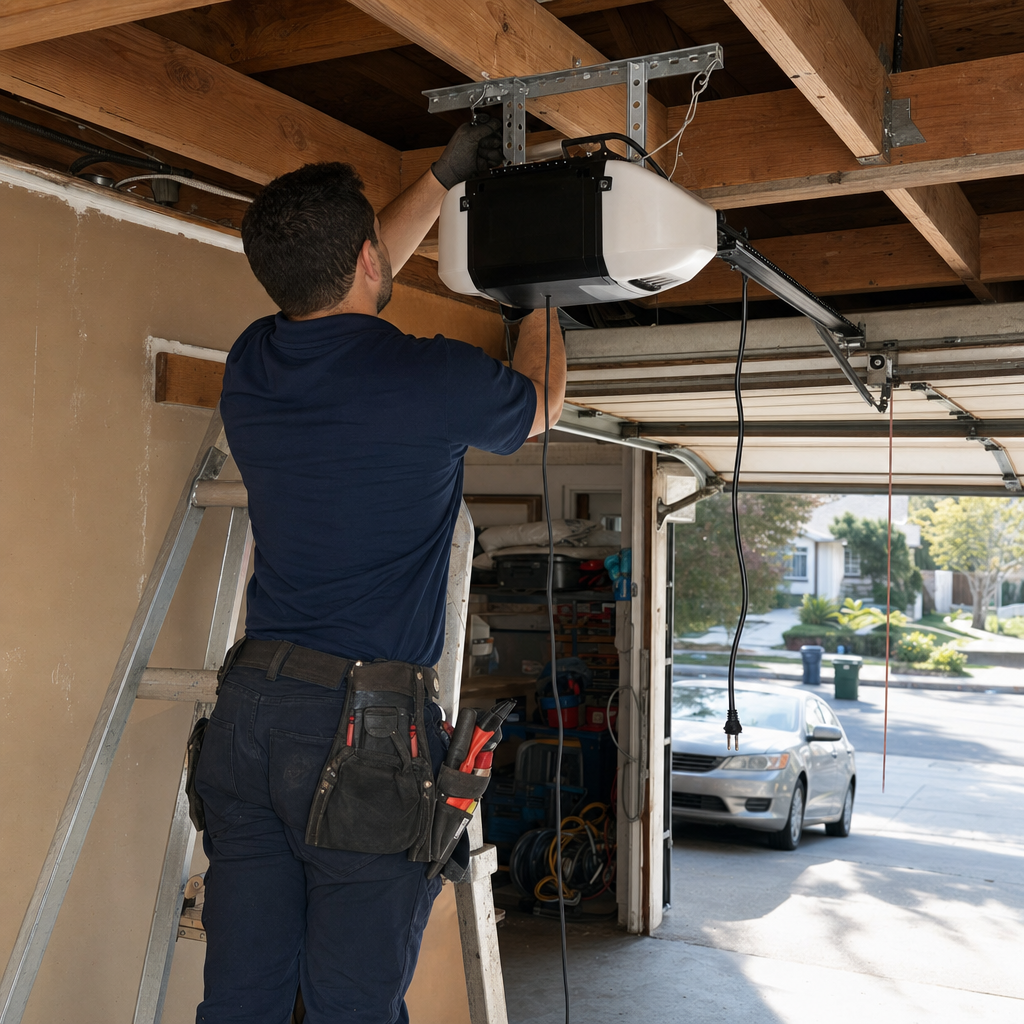
Last updated June 28, 2026
The Complete Guide to Garage Door in Northridge
Your garage door is the largest moving part of your home — and in Northridge, it works harder than almost anywhere else in Los Angeles County. The San Fernando Valley’s temperature swings can hit 40°F between a cool morning and a scorching afternoon, and summer highs routinely push past 100°F. That kind of thermal stress cycles through your springs, cables, seals, and panels every single day. Most guides written for a national audience ignore those conditions entirely. This one doesn’t. Whether you’re buying a new door, nursing an aging one, or trying to figure out whether today’s problem is a $150 fix or a $1,500 replacement, you’ll find a straight answer here — built from eight years of service calls right here in Northridge.
Quick Answer
A garage door in Northridge needs to be chosen and maintained with the San Fernando Valley’s high-UV, low-humidity, triple-digit summer climate in mind — that means steel or aluminum construction with insulation rated at least R-12 for attached garages, regular weatherstripping checks every spring and fall, and annual professional tune-ups before peak heat season. Most repairs — springs, cables, rollers, openers — run between $150 and $450 and can be completed same day by a qualified technician. Replacement doors typically range from $900 to $3,500 installed, depending on size, material, and insulation level.
Table of Contents
- How Northridge’s Climate Affects Your Garage Door
- Best Door Styles and Materials for Northridge Homes
- Choosing the Right Insulation R-Value for a Valley Garage
- What Breaks Most Often — and Why
- Repair, Replace, or Tune-Up? A Decision Framework
- Garage Door Openers: What Works Best in Northridge
- A Seasonal Maintenance Checklist for Northridge Homeowners
- Common Mistakes to Avoid
How Northridge’s Climate Affects Your Garage Door
Most homeowners don’t connect a cracked weatherstrip or a faded panel to the weather — but the Valley’s climate is one of the most punishing environments a garage door faces outside of the desert Southwest. Northridge averages more than 280 sunny days per year, and UV radiation at this inland elevation degrades painted steel, aluminum, and vinyl finishes measurably faster than it does in coastal neighborhoods like Santa Monica or Malibu, where marine layer provides partial protection for significant parts of the day.
Low humidity is the other factor almost every national guide misses. Coastal climates keep wood swollen and seals supple. In Northridge, the combination of dry air and heat causes rubber weatherstripping to harden and crack, wooden doors to gap at the panels, and bottom seals to shrink away from the floor — all of which compromise both energy efficiency and security. We see this pattern on service calls throughout the 91324 and 91325 zip codes, particularly on doors that haven’t had a maintenance visit in two or more years.
Then there’s the seismic factor. Northridge is still rebuilding its identity around the 1994 Northridge Earthquake, and a large percentage of the housing stock dates to post-quake reconstruction. Those homes were built to stricter framing standards, but they also introduced a wave of builder-grade garage doors that are now 25 to 30 years old and well past their useful service life. Thermal expansion and contraction over three decades accelerates spring fatigue, cable wear, and track misalignment — problems Anthony Thompson encounters on a regular basis throughout the Reseda Boulevard corridor and neighborhoods near Cal State Northridge.
Best Door Styles and Materials for Northridge Homes
Northridge’s post-1994 rebuild era produced a housing landscape that mixes Spanish Colonial, ranch-style, and contemporary tract designs. The door you choose should complement that architecture while holding up to Valley conditions — which rules out a few popular materials right away.
Steel
Steel is the most practical choice for the majority of Northridge homes. It resists warping in dry heat, holds paint well when factory-finished with a high-quality baked-on coating, and is available from reliable brands like Clopay, Amarr, and Wayne Dalton in a range of styles that suit both traditional and modern facades. A 24-gauge or heavier steel door will outlast a lighter-gauge model significantly in high-UV conditions.
Aluminum
Aluminum works especially well on contemporary homes — the kind you see in newer builds near Northridge’s Sherwood Forest neighborhood — where a full-view glass-panel design is desirable. It won’t rust and weighs less than steel, which reduces wear on springs and openers. The trade-off is that aluminum dents more easily, so it’s a less practical choice for homes with kids playing in the driveway.
Wood and Wood Composite
Solid wood doors look beautiful but require real commitment in Northridge’s climate. Without biannual resealing and painting, dry Valley air will cause panels to crack and gap within a few years. Wood composite — essentially a fiberglass or steel door with a wood-grain skin — gives you the aesthetic without the high maintenance and is a reasonable middle ground for homeowners who want curb appeal without constant upkeep.
Fiberglass
Fiberglass resists warping and humidity swings well, but it can become brittle under prolonged UV exposure — which is exactly what Northridge delivers. If you go this route, choose a product with a UV-stabilized finish and plan on inspecting it annually for surface crazing.
Choosing the Right Insulation R-Value for a Valley Garage
In Northridge, garage insulation isn’t a luxury — it’s a practical decision that affects your utility bill, the comfort of any living space above or adjacent to the garage, and the longevity of anything you store inside (including your car’s interior). The San Fernando Valley sees summer highs that regularly exceed 100°F, and an uninsulated attached garage can push interior temperatures to 130°F or more, driving radiant heat into your home and forcing your HVAC system to compensate.
Here’s a practical breakdown of R-values and where they make sense for Northridge conditions:
- R-6 to R-9: Adequate for a detached garage where you’re not concerned about heat transfer to living space. Provides basic thermal buffering.
- R-12 to R-16: The recommended minimum for an attached garage in Northridge. This range meaningfully reduces heat transfer through the door and is what most quality Clopay and Amarr insulated doors in the mid-range price tier deliver.
- R-18 to R-32: Worth the investment if your garage shares a wall with a bedroom, home office, or finished living space. High-end options from Wayne Dalton and Clopay reach into this range and can make a noticeable difference on 100°F+ days.
Keep in mind that R-value only tells part of the story. The door’s perimeter seal and bottom weatherstrip are the points where conditioned air actually escapes — a perfectly insulated door with a cracked bottom seal still lets heat pour in. In our experience, replacing a deteriorated bottom seal (a $60 to $120 service call) delivers measurable comfort improvement even before upgrading the door itself.
What Breaks Most Often — and Why
After eight years of service calls throughout Northridge and the broader San Fernando Valley, Anthony has seen the same failure patterns repeat with enough consistency to make a few confident predictions. Understanding them is the first step toward preventing them.
Torsion Springs
Springs are rated for a specific number of cycles — typically 10,000 for standard springs — and Northridge’s temperature swings accelerate metal fatigue beyond what those cycle ratings assume in moderate climates. A spring that might last 10 years in a mild coastal city can fail in 7 to 8 years in the Valley. In the Northridge area, spring failures spike noticeably in late October and early November when nighttime temperatures drop sharply after summer heat — the rapid contraction is hard on already-fatigued metal. Spring repair or replacement runs $180 to $320 depending on the spring type and whether both springs need replacement (replacing both at the same time is almost always the smarter call).
Weatherstripping and Bottom Seals
As noted above, Northridge’s dry air hardens rubber seals faster than the national average. We see cracked, brittle bottom seals on doors that are only 4 to 5 years old when they haven’t been maintained. This is a low-cost fix — $60 to $120 — but it’s one of the most impactful ones for energy efficiency and pest exclusion.
Opener Circuit Boards and Logic Boards
Heat kills electronics. Garage spaces in Northridge that lack insulation can sustain temperatures that shorten the lifespan of opener circuit boards significantly. LiftMaster and Chamberlain openers are generally more heat-tolerant than budget-tier units, but any opener mounted in an uninsulated garage faces real thermal stress. Logic board replacement typically runs $120 to $250.
Rollers and Hinges
Nylon rollers are the quiet, long-life choice — and they’re what Anthony recommends on nearly every tune-up. Steel rollers are louder and transfer more vibration into the door frame. In Northridge’s heat, steel rollers also expand slightly at high temperatures, which can cause binding and accelerated track wear. Roller replacement runs $95 to $180 for a full set.
Cables
Cable failures often follow spring failures — when a spring breaks suddenly, the cable takes a shock load it wasn’t designed for. Inspecting cables at every tune-up catches fraying before it becomes an emergency. Cable replacement is typically $95 to $175.
Repair, Replace, or Tune-Up? A Decision Framework
This is the question Anthony gets most often on service calls. Here’s a straightforward way to think through it based on what we see in Northridge every week.
- Door is under 10 years old, one component has failed: Repair it. A single broken spring, cable, or roller on a relatively young door is a maintenance event, not a signal to replace. Budget $150 to $350 and move on.
- Door is 10 to 20 years old, minor issues: Schedule a professional tune-up ($99 to $179) and get an honest assessment. At this age, multiple small problems often exist simultaneously — a tune-up surfaces them before they compound.
- Door is 20 to 30 years old (common in the post-1994 rebuild era): Replacement is likely the smarter investment. Parts availability narrows on older doors, and the labor cost of repeated repairs can approach the cost of a new door within 2 to 3 years. A new insulated steel door installed in Northridge typically runs $900 to $2,200 for a single-car door and $1,400 to $3,500 for a two-car door, depending on material, insulation, and style.
- Door has structural panel damage (dents, cracks, warping): Panels on some doors can be replaced individually ($250 to $600 per panel), but only if the model is current enough for parts to be available and if the damage is isolated. Widespread panel damage usually means replacement.
- Door is off-track or has bent tracks: This is a same-day repair in most cases ($125 to $250), but if it’s happened more than once, inspect the springs and opener — something upstream is usually causing the problem.
- Opener is malfunctioning and door is aging: If both need attention at the same time, it’s often worth bundling a new door and opener installation together — you’ll save on labor and start fresh with matched, warranted components.
For a deeper look at new door options and what installation costs look like in the current Northridge market, our Garage Door Installation in Northridge page walks through the full process.
Garage Door Openers: What Works Best in Northridge
The opener market has changed significantly in the past five years, and the options available to Northridge homeowners today are meaningfully better than what most people replaced in the post-1994 era. Here’s what actually matters for Valley conditions.
Belt Drive vs. Chain Drive vs. Direct Drive
Belt drive openers (LiftMaster, Chamberlain) run quieter and transfer less vibration to the door frame — an important consideration if a bedroom is above or adjacent to the garage. Chain drive units cost less and are extremely durable, but they’re noticeably louder. Direct drive systems (Genie’s StealthDrive line, for example) have a single moving part and are exceptionally reliable in hot environments because there’s simply less to fail.
Smart Features and Battery Backup
During Northridge’s hot summers, power outages are not uncommon — the grid is under stress when every household is running AC simultaneously. An opener with battery backup means your door works even when the power doesn’t. LiftMaster’s 87504-267 and Chamberlain’s B6765T both offer this feature and are brands Anthony is certified to service. For smart home integration, myQ-compatible openers let you monitor and control your door from a phone — useful for households that frequently ask “did I close the garage?”
Horsepower
A ½ HP opener handles most single-car doors comfortably. For heavy two-car doors — particularly older solid wood doors or any door over 400 lbs — a ¾ HP or 1 HP model protects the motor from overheating during Northridge’s extended summer seasons. Undersized motors fail early in high-heat environments.
Our Garage Door Opener in Northridge page covers brand comparisons, installation costs, and smart-home compatibility in more detail.
A Seasonal Maintenance Checklist for Northridge Homeowners
Northridge’s climate creates two meaningful maintenance windows each year: spring (before peak heat season) and fall (when temperatures begin to drop sharply). Here’s what to check at each window — and what to leave to a professional.
What You Can Do Yourself
- Visual inspection of springs and cables: Look for visible gaps in the spring coil, frayed cable strands, or rust. If you see any of these, call a professional — don’t operate the door.
- Lubricate moving parts: Apply a silicone-based or lithium-based spray (not WD-40, which attracts dirt) to the rollers, hinges, and the torsion spring coil. Do this every 6 months.
- Test the auto-reverse feature: Place a 2×4 flat on the ground in the door’s path and close the door. It should reverse immediately upon contact. If it doesn’t, the opener needs adjustment — call a tech.
- Check weatherstripping: Run your hand along the sides and top seal. If you feel gaps or the rubber crumbles when you flex it, replacement is due. In Northridge’s dry climate, this degrades faster than most guides suggest — inspect it twice a year, not once.
- Clean the photo-eye sensors: Wipe the lenses with a soft cloth. Dusty sensors are a common cause of doors that refuse to close.
- Listen for unusual noises: Grinding, scraping, or a loud bang when operating signals a component under stress. Note when it started and where in the door’s travel it occurs — that information helps a technician diagnose faster.
What a Professional Should Handle Annually
- Spring tension adjustment and cycle-count assessment
- Cable tension and drum inspection
- Track alignment check and fastener tightening
- Opener force and sensitivity calibration
- Full bottom seal and perimeter seal inspection
- Structural panel condition review
An annual professional tune-up in Northridge typically runs $99 to $179 and catches small problems before they become emergency calls. For a detailed overview of what repair visits cover and typical pricing ranges, see our Garage Door Repair in Northridge page.
Common Mistakes to Avoid
- Ignoring weatherstripping until winter: In Northridge, the real damage from degraded weatherstripping happens in summer, not winter — hot air infiltration and pest entry start the moment seals crack. Check seals every spring, not just before the cold comes.
- Using WD-40 as a lubricant: It’s a solvent, not a long-term lubricant, and it leaves a residue that attracts the fine dust Northridge gets during dry Santa Ana conditions. Use white lithium grease or a dedicated garage door lubricant spray instead.
- Replacing only one spring when two have failed together: If one spring breaks, the other is typically at the same point in its wear cycle. Replacing both at once saves a second service call within months — and the second spring breaking is a predictable outcome, not bad luck.
- Buying a replacement door without checking insulation R-value: The visual appeal of a door matters, but in a Valley climate that hits 105°F in August, an R-6 door on an attached garage is a thermal liability. Always verify R-value before purchasing, not after.
- Assuming a noisy door just needs oil: A loud door is your system telling you something. Grinding often signals worn rollers or a track problem. A sharp bang suggests a spring under stress. Lubrication masks the symptom; a professional inspection finds the cause.
- Hiring a general handyman for spring or cable work: These components are under extreme tension — a torsion spring holds enough stored energy to cause serious injury if released incorrectly. This is one area where verified, experienced specialty work is not optional.
- Waiting until the door fails completely before calling: A door that’s slow, jerky, or unusually loud is a door giving you advance warning. Acting on early symptoms almost always costs less than responding to a full failure — and it avoids the scenario of a door stuck open or stuck closed at the worst possible time.
When to Call a Professional
Some garage door tasks are genuinely DIY-friendly — cleaning sensors, lubricating hinges, replacing a remote battery. Others are not, and the line matters more than most homeowners realize.
Call a professional immediately if you notice a broken or visibly cracked spring, a snapped or frayed cable, a door that has come off its tracks, panels that are buckled or misaligned after an impact, or an opener that reverses on its own, runs continuously, or won’t respond to any input. These aren’t situations to troubleshoot over the weekend — a door operating with a damaged spring or cable can fail suddenly and create a safety hazard.
Also call a pro any time your door makes a new noise it didn’t make before, moves unevenly, or takes noticeably more time to open or close than it used to. Early intervention almost always means a lower repair bill.
Victory Garage Door Solutions Northridge offers free estimates on every job — call (424) 437-2670 and Anthony will give you a straight answer about what your door needs before any work begins.
Frequently Asked Questions
Most garage door repairs in Northridge fall between $150 and $450, depending on the component. Spring replacement runs $180 to $320, cable replacement $95 to $175, roller replacement $95 to $180, and weatherstrip replacement $60 to $120. Opener repairs — including logic board replacement — typically range from $120 to $300. Call (424) 437-2670 for a free estimate specific to your door’s issue.
A quality steel or aluminum door installed in Northridge will typically last 20 to 30 years with proper maintenance. However, the Valley’s UV intensity and temperature swings mean finish degradation, weatherstrip failure, and spring fatigue happen faster than in milder climates — plan on more frequent maintenance visits than a national “every few years” guideline suggests.
If your door is under 10 years old and only one component has failed, repair it. If it’s 20 years or older — which describes a large share of the post-1994 rebuild housing stock in Northridge — and it’s showing multiple problems simultaneously, replacement is usually the better financial decision over a 3 to 5 year horizon. A free estimate from a specialist will make this comparison concrete for your specific door. Call (424) 437-2670 for a no-pressure assessment.
Belt drive or direct drive openers from LiftMaster or Chamberlain perform well in high-heat environments because they generate less friction heat than chain drive units and run quieter. For households that experience summer power outages, an opener with battery backup is worth the additional cost — LiftMaster and Chamberlain both offer reliable battery-backup models that Anthony regularly installs throughout Northridge.
Once a year is the standard recommendation, and in Northridge we’d suggest timing it for late February or early March — before the heat season begins and before springs face their most stressful operational period. A tune-up at this time lets a technician calibrate tension, lubricate components, and replace anything showing wear before you hit the months of daily 100°F operation.
Yes — the majority of common repairs, including spring replacement, cable repair, roller replacement, and opener service, can be completed on the same visit. Parts for the most common door and opener brands — Clopay, Amarr, LiftMaster, Chamberlain, Genie, Wayne Dalton, Craftsman, and Raynor — are stocked for same-day work. Call (424) 437-2670 to confirm availability and schedule a visit.
The Bottom Line
Your garage door works harder in Northridge than it would almost anywhere else in the Los Angeles metro. The combination of triple-digit summer heat, intense UV exposure, dry air, and the age of the post-1994 housing stock creates a specific set of failure patterns that generic advice doesn’t address. The practical takeaways from this guide: choose insulated steel or aluminum, verify your R-value before buying, inspect weatherstripping twice a year, and schedule a professional tune-up every spring. When something sounds wrong, call early — 1,455 Northridge-area customers have found that Anthony Thompson’s approach to honest, owner-accountable service makes the decision easy. Reach Victory Garage Door Solutions Northridge at (424) 437-2670 for a free estimate.
Written by Anthony Thompson, Owner & Lead Technician at Victory Garage Door Solutions Northridge, serving Northridge since 2018.