
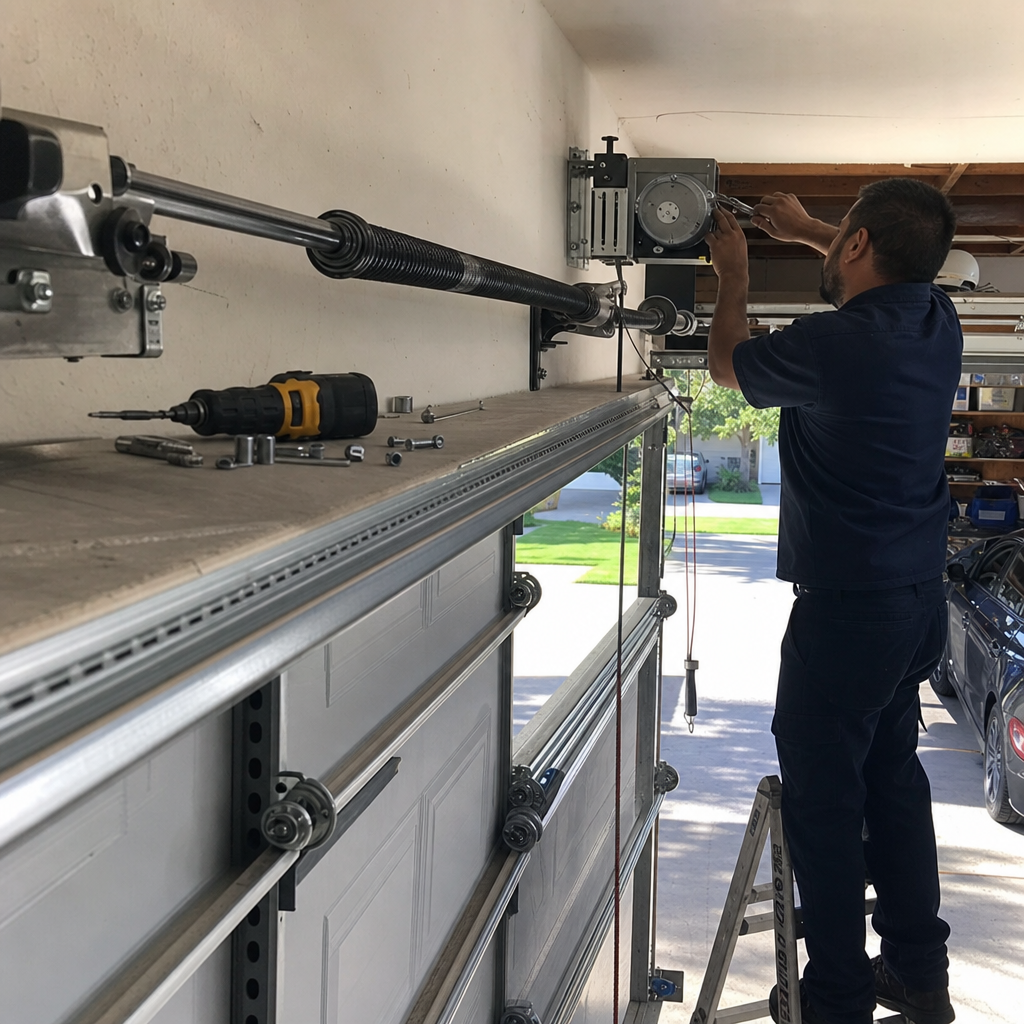
Last updated June 28, 2026
Garage Door Permits, Codes & Inspections in CA: What You Need to Know
Most homeowners assume replacing or repairing a garage door is a simple swap — no paperwork, no inspector, no waiting. That assumption is correct most of the time. But California’s building code has specific carve-outs that catch people off guard, and if you’re in Northridge or anywhere else in LA County, the jurisdictional overlap between the county and the City of Los Angeles adds another layer that even some contractors overlook. Skip the wrong permit, and you could face a stop-work order, a failed home sale inspection, or worse — a liability gap if someone gets hurt. This guide walks through exactly when permits apply, what California-specific codes govern garage door installations, and how to make sure your project is fully above board.
Quick Answer
Most garage door repairs and like-for-like spring or panel replacements in California do not require a permit. However, full door replacements — especially in LA County on homes built before 1978 — and new opener installations on older homes can trigger permit and inspection requirements. In Northridge specifically, any structural modification to the garage opening or an opener installation that requires new electrical work will almost always need a permit from the City of Los Angeles Department of Building and Safety (LADBS).
Table of Contents
- When Is a Garage Door Permit Required in California?
- LA County vs. City of Los Angeles: The Jurisdiction Question That Affects Northridge
- Seismic Disconnect Requirements: The Code Point Born from the Northridge Earthquake
- UL 325 Compliance: What It Means for Your Opener Installation
- HOA Rules vs. Municipal Codes: Which One Controls Your Project?
- What Actually Happens During a Garage Door Inspection in California
- Common Mistakes to Avoid
- When to Call a Professional
- Frequently Asked Questions
- The Bottom Line
When Is a Garage Door Permit Required in California?
California follows the California Building Code (CBC), which is built on the International Building Code with state amendments. Under the CBC, a permit is required for any work that involves a structural change, new electrical installation, or a change to the size or framing of an existing opening. The key word most homeowners miss is structural.
Here’s a practical breakdown of where the line falls:
- No permit required: Replacing springs, cables, rollers, or hinges on an existing door. Swapping a door panel for an identical replacement. Replacing an opener with a new unit of the same voltage on existing wiring.
- Permit likely required: Installing a garage door in a new opening or enlarging an existing one. Adding a new 240V circuit for an opener where no dedicated circuit previously existed. Replacing a door on a pre-1978 home if the framing or header must be modified. Converting a single-car opening to a double-car opening.
- Always verify locally: Some California cities — including Los Angeles — have adopted local amendments that are stricter than the base CBC. What doesn’t need a permit in unincorporated LA County may still require one within Los Angeles city limits.
The safest rule of thumb: if the job touches framing, electrical, or changes the rough opening dimensions, pull a permit. The cost of a permit is almost always less than the cost of undoing unpermitted work during a home sale.
LA County vs. City of Los Angeles: The Jurisdiction Question That Affects Northridge
This is the single most common source of confusion for homeowners in the San Fernando Valley, and it directly affects Northridge addresses. Northridge is a neighborhood within the City of Los Angeles, not in unincorporated LA County. That distinction matters enormously for permitting.
Unincorporated LA County falls under the LA County Department of Public Works, Building and Safety Division. The City of Los Angeles falls under the Los Angeles Department of Building and Safety (LADBS). These are two separate agencies with different fee schedules, different online portals, and different inspection workflows. A contractor who is accustomed to pulling permits in, say, unincorporated areas of the Valley may not be familiar with the LADBS ePlans system that Northridge projects require.
For Northridge homeowners specifically, here’s what this means in practice:
- Verify jurisdiction first. Use the LADBS Zoning Information and Map Access System (ZIMAS) to confirm your parcel’s jurisdiction. Enter your address at the LADBS portal and check the “Jurisdiction” field before assuming anything.
- Use the correct permit type. LADBS uses a “combination permit” that can cover both mechanical and electrical work under one application for garage door projects — this often reduces total permit cost compared to pulling separate permits.
- Know the plan check threshold. In Los Angeles, projects under a certain valuation can sometimes use “over-the-counter” plan check (same-day), while larger structural projects require a formal plan check that can take days or weeks.
In our experience working throughout Northridge and the surrounding Valley neighborhoods, the LADBS online portal has made permit submission faster — but the inspectors are rigorous, and a job that doesn’t meet code on the first inspection means a re-inspection fee and delay. Getting it right the first time saves everyone time and money.
Seismic Disconnect Requirements: The Code Point Born from the Northridge Earthquake
If there’s one California-specific garage door code point that almost no out-of-state contractor knows — and too many local ones gloss over — it’s the seismic disconnect requirement for automatic garage door openers.
The January 17, 1994 Northridge earthquake was a turning point for California building codes across dozens of categories. One of the less-publicized lessons was about automatic garage door openers: when power fails during a seismic event and the opener’s carriage is locked in place, occupants can be trapped inside a garage if the door is warped or the opener is damaged. California subsequently reinforced requirements around manual release mechanisms, and today’s California Electrical Code and the UL 325 standard both address emergency release provisions that are non-negotiable on new installations.
What this means for a Northridge homeowner replacing or upgrading an opener:
- Every automatic opener installed in California must have a manual emergency release cord — the red cord hanging from the carriage — that is functional and accessible from inside the garage without tools.
- The release mechanism must disengage the door from the opener within seconds of pulling the cord, allowing the door to be operated manually.
- On new installations, the opener must be installed so the release cord is reachable by a person of average height from the floor — not buried behind storage shelving or obstructed.
- Openers that have had their manual release mechanism disabled, removed, or damaged should be replaced, not repaired around the issue. We see this occasionally on older Craftsman and Wayne Dalton units that have been jury-rigged by previous owners.
This isn’t just a code requirement — it’s a life-safety issue that resonates differently when you’re in a community that lived through the 1994 earthquake firsthand. When Anthony inspects an opener installation in Northridge, verifying the emergency release is one of the first checks, every time.
UL 325 Compliance: What It Means for Your Opener Installation
UL 325 is the Underwriters Laboratories safety standard that governs automatic residential garage door operators in the United States. California enforces it, and any opener sold or installed in the state is required to meet the current version of this standard. Here’s why it matters beyond the regulatory checkbox:
What UL 325 actually requires:
- Entrapment protection: Every opener must have a secondary entrapment protection device — typically a photoelectric sensor (the “safety eyes” mounted near the floor on either side of the door track) that reverses the door if a beam is broken.
- Auto-reverse: The door must automatically reverse if it contacts an object while closing. The opener’s closing force must be set to meet specific limits — not so much force that it could injure a person or pet.
- Wall button and remote control requirements: Controls must be positioned or secured to prevent unintended operation by children.
The critical issue we see in the field: used or refurbished openers that predate the 1993 UL 325 revision do not have photoelectric sensors and cannot be made compliant by adding aftermarket sensors alone. Installing one of these units — something fly-by-night operators sometimes do to offer a lower price — puts a homeowner in violation of California code and creates real liability exposure.
Every opener we install from brands like LiftMaster, Chamberlain, Genie, and Craftsman is a current-production unit that ships UL 325-compliant from the factory. That’s not a upsell — it’s the floor, not the ceiling, of what a proper installation looks like. If a quote you’ve received seems unusually low for an opener installation, ask whether the unit being installed is new and UL 325 current. The answer will tell you a lot.
HOA Rules vs. Municipal Codes: Which One Controls Your Project?
Northridge has a number of neighborhoods governed by homeowners associations — particularly in the areas west of Reseda Boulevard and in planned communities built in the 1970s and 1980s. If your home is subject to an HOA’s CC&Rs (Covenants, Conditions, and Restrictions), you’re dealing with two separate approval tracks that operate independently of each other.
The short answer on precedence: Municipal code is the legal floor — it applies to everyone regardless of HOA membership, and HOAs cannot grant exceptions to building codes. However, HOAs can be more restrictive than municipal code for aesthetic and community standards purposes.
What this means practically:
- You may need both an LADBS permit (for a full door replacement on a home with structural header work) and HOA architectural committee approval (for the door style, color, or material).
- HOA approval is typically not a fast process — architectural committee meetings can be monthly. Plan four to six weeks ahead if you’re selecting a non-standard door style from a brand like Clopay, Amarr, or Wayne Dalton that your HOA may need to review.
- Some Northridge HOAs have a pre-approved door list. Ask your HOA management company for this list before you shop for a door — it can save significant back-and-forth.
- If you need a variance (you want a door style not on the pre-approved list), submit a written request with a product spec sheet and a photo rendering. Most HOA architectural committees will respond faster to a well-prepared submission than to a verbal request at a meeting.
One more thing worth knowing: HOA approval does not substitute for a municipal permit, and an LADBS permit does not constitute HOA approval. Both boxes must be checked independently.
What Actually Happens During a Garage Door Inspection in California
If your project does require a permit, an LADBS inspector will visit the site after the work is complete — this is the final inspection. Knowing what they’re looking for helps ensure the job passes on the first visit.
Here’s what a typical garage door inspection covers in Los Angeles:
- Permit documentation on site. The permit card must be posted or available at the job site. The inspector will check that the work described on the permit matches what was done.
- Structural header and framing. If the permit covers framing work, the inspector will verify that the header size is adequate for the span and load, and that all framing connections are properly fastened per the approved plans.
- Opener installation compliance. The inspector will check that the opener is mounted per manufacturer specifications, that the rail is properly secured, and that the ceiling-mounted power unit has adequate clearance.
- Safety sensor placement and function. Photoelectric sensors must be mounted no more than six inches from the floor on both sides of the door, properly aligned, and functional — the inspector will test this by breaking the beam while the door closes.
- Manual release. The emergency release cord must be accessible and functional. The inspector may pull the cord and attempt to manually lift the door to verify it disengages properly.
- Auto-reverse test. The inspector may place a 2×4 flat on the ground under the door and initiate a close cycle. The door must reverse automatically upon contact.
- Electrical work (if applicable). New circuits, junction boxes, and wiring must meet NEC and California Electrical Code requirements — proper wire gauge, GFCI protection if required, and a dedicated circuit if that’s what was installed.
A qualified contractor prepares for every one of these checkpoints before the inspector arrives. We’ve seen jobs from other contractors fail final inspection because the safety sensors were mounted too high or the manual release cord was routed against the garage ceiling and out of reach. These are not surprises — they’re standard checklist items.
Common Mistakes to Avoid
- Assuming no structural work means no permit. In LA, even a full door replacement that doesn’t touch framing can require a permit if the opener installation involves new electrical work. Always verify with LADBS before starting, not after.
- Confusing LA County and City of LA permit requirements. Northridge is inside the City of Los Angeles. Using county-issued permits or calling the wrong agency is a mistake that can delay your project significantly when it surfaces during a home sale title search.
- Installing a used opener without confirming UL 325 compliance. Pre-1993 openers lack the safety sensor technology required by California code. Installing one to save a few hundred dollars creates a code violation and a homeowner liability issue that will cost far more to resolve later.
- Skipping HOA architectural approval on a door replacement. In some Northridge HOA communities, replacing a door without written approval — even with a city permit in hand — can result in mandatory removal and replacement at the homeowner’s expense.
- Not pulling a permit on a pre-1978 home replacement. Homes built before 1978 may trigger additional inspection requirements under LA’s older housing amendment provisions. A permit creates a documented record that the work was done to code — something buyers and title companies increasingly require.
- Hiring a contractor who doesn’t know the seismic release requirement. It sounds basic, but we’ve encountered installations in Northridge where the manual release cord had been removed or tied off “to keep the door from opening accidentally.” This is both a code violation and a safety hazard.
- Completing the work and forgetting to schedule the final inspection. An open permit with no final inspection recorded is treated as unpermitted work by title companies. Always close out the permit by scheduling and passing final inspection.
When to Call a Professional
Call a licensed, experienced garage door contractor — not a general handyman — in any of these situations: you’re replacing a full door and aren’t certain whether a permit is required; the rough opening size is changing in any direction; you’re adding a new opener circuit where no dedicated line exists; the header above the door shows any sign of sagging, cracking, or prior patch work; you’re in an HOA community and need documentation for the architectural committee; or you’ve just purchased a home and discovered the previous owner’s garage door work has no permit on record.
Victory Garage Door Solutions Northridge offers free estimates in Northridge and across the San Fernando Valley. Anthony Thompson handles the assessment personally — the same person who will do the work. Call (424) 437-2670 and get a straight answer about what your project actually needs, including whether a permit applies to your specific situation.
Frequently Asked Questions
Do I need a permit to replace a garage door in Northridge, CA?
In most cases, a like-for-like garage door replacement in Northridge does not require a permit if the rough opening size stays the same and no new electrical work is involved. However, if the header needs modification, the opening size changes, or the project is on a pre-1978 home with framing concerns, LADBS will require a permit. When in doubt, a quick call to LADBS at their public counter line or a check through ZIMAS can confirm your specific parcel’s requirements. Call (424) 437-2670 for a free assessment — we’ll tell you upfront what applies to your job.
How much does a garage door permit cost in Los Angeles?
Permit fees in the City of Los Angeles are calculated on project valuation, not a flat rate. For a typical residential garage door replacement with opener, you can expect permit fees in the range of $150 to $400 depending on the total project value and whether plan check is required. Combination permits that bundle mechanical and electrical work under one application can reduce total fees compared to pulling separate permits. Your contractor should be able to give you an estimated permit cost before work begins — if they can’t, that’s worth noting.
What is the UL 325 requirement, and does it affect older garage door openers in California?
UL 325 is the federal safety standard for automatic garage door operators. In California, any new opener installation must use a UL 325-compliant unit — meaning it must include photoelectric safety sensors and an auto-reverse function. Openers manufactured before 1993 do not meet this standard and cannot be brought into compliance through aftermarket modifications alone. If your existing opener predates 1993, replacing it entirely is both a code requirement for any permitted work and a genuine safety upgrade. We don’t install used or non-compliant openers — brands like LiftMaster, Genie, and Chamberlain ship every current production unit UL 325-ready.
Do Northridge HOA rules override city building codes for garage doors?
No. City of Los Angeles building codes are the legal minimum and cannot be waived by an HOA. What HOAs can do is impose additional aesthetic or material requirements on top of municipal code — such as requiring a specific door color, style, or material that matches the community standard. For a Northridge homeowner in an HOA community, this means you may need both an LADBS permit and written HOA architectural approval before installing a new door. These are two separate processes, and neither one substitutes for the other.
What is the seismic disconnect requirement for garage doors in California?
California requires all automatic garage door openers to have a functional manual emergency release mechanism — the red cord hanging from the opener carriage — that can disengage the door from the drive system without tools and without power. This requirement was reinforced after the 1994 Northridge earthquake, when post-event analysis showed that trapped occupants in garages with damaged openers could not exit because the manual release was inaccessible or non-functional. Any opener installation in California must pass an emergency release test before it’s considered code-compliant. This is a standard part of every installation we do in Northridge.
What happens if I sell my home and there’s an unpermitted garage door installation?
Unpermitted work shows up during a buyer’s title search or a home inspection, and it can stall or kill a home sale. In Los Angeles, unpermitted structural or electrical work typically requires the seller to either retroactively permit the work (which may require exposing and correcting it) or negotiate a price reduction with the buyer. On garage door projects, the most common issue we see surfaces when an opener was installed with new electrical wiring but no permit was pulled. Pulling a permit and getting a final inspection at the time of installation — even if it adds a few days — is far cheaper than addressing it under deadline pressure during escrow.
The Bottom Line
California’s garage door permit rules are narrower than most homeowners expect — the majority of repairs and straightforward replacements don’t require a permit. But the exceptions are real and carry consequences: full replacements with structural changes, new electrical circuits for openers, and any work on pre-1978 homes in LA can all trigger LADBS requirements. Add California-specific seismic release rules, UL 325 compliance for openers, and HOA approval processes, and it becomes clear why hiring a contractor who knows this territory matters. In Northridge especially, the City of Los Angeles jurisdiction means a different agency, a different process, and a different inspector than many contractors expect. Getting it right from the start is always less expensive than fixing it later. For a Garage Door Repair in Northridge or a full Garage Door Installation in Northridge, working with someone who’s been navigating these requirements in this community for eight years makes a tangible difference. Whether you need an opener assessment or want to learn more about our full range of services, you can start at the Victory Garage Door Solutions Northridge home page or explore our dedicated Garage Door Opener in Northridge service page for more detail.
If you’re unsure whether your project needs a permit, don’t guess — call (424) 437-2670 for a free estimate. Anthony will give you a straight answer based on your specific address and project scope. No runaround, no upselling what you don’t need.
Written by Anthony Thompson, Owner & Lead Technician at Victory Garage Door Solutions Northridge, serving Northridge since 2018.